Skinny Fat: Why You Look Soft Even Though the Scale Says You're Fine
This one comes up constantly in first consultations. Someone sits down, tells me their weight is "normal," their BMI checks out, they've been watching what they eat for years — and then they pull at the skin around their stomach or their arms and say some version of: "so why does this still look like this?"
If that's you, you're not imagining it, and you're not failing at discipline. You're dealing with a body composition problem that has almost nothing to do with how much you weigh.
What "Skinny Fat" Actually Means
In the research literature this is usually called normal-weight obesity, or sometimes sarcopenic obesity — a body that carries a normal or even low body weight, but a body fat percentage that's meaningfully higher than it should be, paired with a lower-than-ideal amount of muscle. Your scale weight looks fine because muscle and fat are both just mass — the scale can't tell the difference between the two, and neither can BMI, which was never designed to measure body composition in the first place.
This isn't just a look-in-the-mirror issue. Carrying a normal weight with a high body fat percentage and low muscle mass has been linked in research to worse insulin sensitivity and higher cardiometabolic risk than the number on the scale would suggest — which is part of why it's worth actually fixing, not just tolerating.
How You End Up Here
Nobody arrives at skinny-fat on purpose. It's usually the sum of a few ordinary habits, repeated for years:
Years of cardio without resistance training. Running, spin classes, boxing cardio, HIIT circuits — all genuinely good for your heart and your fitness, but none of them send your body a strong enough signal to actually build or protect muscle. If that's been the entire exercise diet, you can be in decent cardiovascular shape and still be losing muscle mass year over year.
Repeated dieting without a training plan behind it. Every time you cut calories aggressively without resistance training in the mix, your body doesn't selectively burn fat — it burns whatever's easiest to let go of, and muscle tissue is metabolically expensive to maintain, so a meaningful chunk of what you lose tends to be muscle rather than fat. Do that two or three times over a decade — a new diet before every summer, every wedding, every trip — and the muscle loss compounds even if your weight always bounces back to roughly the same number.
A desk-bound, air-conditioned life. This one is almost universal in Dubai specifically. Between a desk job, a car for every errand, and roughly five months a year where being outside for any length of time is unpleasant, the incidental daily movement that used to keep people's muscle and metabolism ticking over has quietly disappeared for a lot of people, and nobody really notices it happening.
Not eating enough protein to matter. "Eating clean" and "eating enough protein" are not the same thing, and a lot of people doing the former are nowhere near the latter.
None of this is a character flaw. It's what happens by default when nobody's specifically training you to hold onto muscle.
Why Eating Even Less Doesn't Fix It
This is the part that trips people up the most, because it's counterintuitive. The instinct when you don't like what you see is to cut more food. For skinny-fat, that usually makes things worse, not better.
There's a well-known randomized trial from 2016 (Longland et al., published in the American Journal of Clinical Nutrition) that's relevant here: young men in a calorie deficit, all doing intense exercise, were split into a higher-protein group (about 2.4g per kg of bodyweight) and a lower-protein group (about 1.2g per kg). Both groups lost roughly the same amount of weight. But the higher-protein group gained lean muscle mass while losing fat, and the lower-protein group lost a meaningful amount of muscle along with the fat. Same deficit, same training stimulus, completely different outcome — the protein target was the deciding factor.
That's essentially the mechanism behind skinny-fat. If you diet without enough protein and without resistance training telling your body "keep this muscle, you're using it," your body treats muscle as expendable. You get lighter, but you get softer, and your metabolism gets slightly worse at handling food every time it happens.
What Actually Works: Recomposition, Not Another Diet
The goal isn't a bigger deficit. It's body recomposition — losing fat and building muscle at the same time, so your body fat percentage drops even if the scale barely moves. It's genuinely possible, especially if you haven't trained with resistance work consistently before, which describes most people dealing with this.
Resistance training, 3–4 times a week, with progressive overload. Compound lifts — squat, hinge, push, pull — done consistently and made slightly harder over time. This is the actual signal that tells your body to hold onto and build muscle instead of just letting it go during a deficit.
Enough protein, consistently. Research on body recomposition generally lands somewhere around 1.6–2.4g of protein per kg of bodyweight per day, distributed across your meals rather than dumped into one. Spread across chicken, fish, eggs, Greek yoghurt, and a protein shake or two if your schedule doesn't allow proper meals — it doesn't need to be complicated.
A modest deficit, not an aggressive one. Somewhere around 10–15% below maintenance is usually enough to lose fat steadily while still giving your body enough fuel to actually build muscle. A bigger deficit doesn't get you there faster — it just increases the odds you lose more muscle along the way, which is the exact problem you're trying to solve.
Patience, because the scale lies for a while. This is the part clients struggle with most. You can drop several centimetres off your waist and visibly change shape while your weight moves only a kilogram or two, because you're losing fat and gaining muscle at roughly the same time. If you're only watching the scale, it'll look like nothing is happening. If you're watching your waist measurement, your strength numbers and how your clothes fit, you'll see the real picture. I wrote more about how this works, including how much genuine simultaneous muscle gain and fat loss is realistic, in our body recomposition breakdown on the blog.
The important distinction: body recomposition isn't simply another way of saying weight loss. The objective is to improve the ratio between muscle and body fat — which means the scale may move slowly while your body changes significantly.
That's also why a weight loss trainer in Dubai should be looking at more than your body weight when the actual goal is to look leaner, stronger and more athletic.
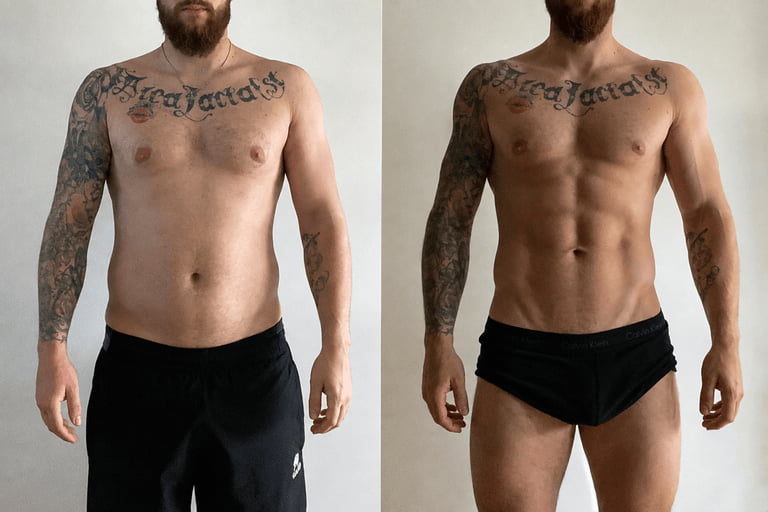
Boris's Body Recomposition Story
Body recomposition makes a lot more sense when you see what it looks like outside a textbook. Boris's case is a good example of why the goal isn't always to make the number on the scale as small as possible — it's to change what that weight is made of.
In his full story, you can see the process behind the transformation, the changes in his body composition and what happened when the focus shifted away from simply trying to lose weight and toward building a stronger, leaner physique.
If you're dealing with the same "skinny fat" problem — a weight that looks fine on paper but a body composition that doesn't reflect how you want to look — Boris's transformation is worth seeing.
See Boris's Full Story & TransformationWhy This Shows Up So Often in Dubai Specifically
A few things about life here make the skinny-fat pattern more common than it might be elsewhere:
- Boutique cardio culture is huge, and a lot of people's entire "fitness routine" is spin, boxing cardio or a running club — all worthwhile, none of it building muscle on its own.
- The pre-summer and pre-wedding-season diet cycle is extremely common among expats specifically, and repeated crash dieting without resistance training is one of the most reliable ways to end up here.
- The heat genuinely removes months of incidental activity most people don't track or think about — walking to lunch, parking further away, doing anything outdoors after 10am from May through September.
None of that means you need to move away from cardio you enjoy. It means resistance training needs to sit alongside it, not get replaced by it.
If you enjoy structured conditioning, there's nothing wrong with keeping it in your program. The important thing is making sure it complements resistance training rather than replacing it. You can read more about how I structure circuit training and other forms of conditioning around the bigger goal.
How I Approach This With Clients
Every skinny-fat client starts the same way — an actual assessment, not a guess: current body fat and lean mass, movement quality, training history, and an honest look at how much protein you're actually eating versus what you think you're eating (these numbers are almost always further apart than people expect).
From there, the program is built around progressive resistance training, a protein target you can hit without hating your life, and a deficit small enough that your body has the fuel to build muscle while it loses fat. No extreme cuts, no cardio-only routines, no plan that assumes you're not also managing a full-time job and a life outside the gym.
Most clients notice their clothes fitting differently and their strength climbing well before the scale reflects much — that's usually the sign it's working exactly as it should.
If the main issue is that you've spent years dieting and exercising without getting the body composition you actually want, the answer isn't necessarily more cardio or another aggressive diet. It's often about changing the way the entire program is structured.
That can include resistance training, nutrition and recovery, with the exact balance depending on the person. If nutrition is one of the weak points, I also offer a personalised nutrition plan alongside training.
If you're also dealing with stubborn abdominal fat, stress and poor recovery, it's worth looking at the bigger picture rather than treating the stomach as an isolated problem. I covered that in more detail in my article on stress belly and the relationship between stress, cortisol, sleep and stubborn abdominal fat.
And if your schedule makes traditional gym training difficult, the same principles can be applied through online training, with the program adjusted around your actual schedule, equipment and lifestyle.
For clients who are trying to lose a significant amount of body fat rather than primarily recomposition, I also explain the broader process in my guide to weight loss training in Dubai.
Book a free consultation and we'll look at where your muscle mass and body fat actually stand, not just what the scale says.
The Goal Isn't to Weigh Less. It's to Look Different.
Skinny-fat isn't a problem that gets solved by chasing a smaller number on the scale. If you're already at a normal body weight but don't like the way your body looks, continuing to lose weight may simply make the underlying problem more obvious.
The better target is body composition: more muscle, less body fat, better strength and a physique that actually reflects the work you're putting in.
Ready to Change Your Body Composition?
If you want to stop guessing and find out what your current body composition actually needs, let's start with a proper assessment and build the plan around your goal.
Book a Free ConsultationFAQ
Yes — this is actually the most common version of it. If your training has been mostly cardio, spin, boxing classes or running without structured resistance work, you can be genuinely fit cardiovascularly while still carrying low muscle mass and a higher-than-ideal body fat percentage.
Most people notice a difference in how clothes fit and how they feel within 8–12 weeks of consistent resistance training and adequate protein. More significant, measurable changes in body fat percentage and lean mass usually take 16–24 weeks, since you're building muscle at the same time as losing fat, which is a slower process than either one alone.
Yes. Muscle protein synthesis becomes somewhat less efficient with age, so it takes a bit more consistency and recovery, but resistance training and adequate protein still work the same way at 45 or 55 as they do at 25. The process just needs to be a little more deliberate.
"Out of shape" usually describes low cardiovascular fitness. Skinny-fat is specifically about body composition — a normal weight combined with a high body fat percentage and low muscle mass. You can absolutely be cardiovascularly fit and still be skinny-fat, which is exactly why the fix is resistance training and protein, not more cardio.